
Global Shipping Schedule Reliability Improves - But Flexibility Remains Essential
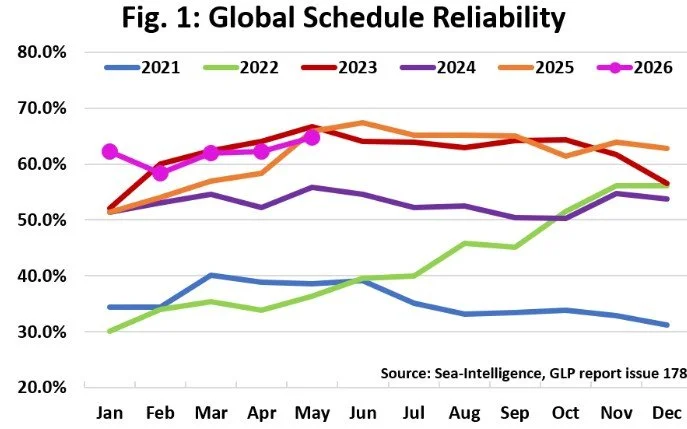
Image credit: Sea Intelligence
The latest Global Liner Performance (GLP) report from Sea-Intelligence shows that global shipping schedule reliability continues to improve, reaching 64.7% in May 2026. This marks a 2.5 percentage point increase from April and represents the highest level recorded so far this year.
While this is encouraging news for global supply chains, it doesn't necessarily mean every shipment will arrive exactly as planned.
What is schedule reliability?
Schedule reliability measures how often container vessels arrive at port according to their published schedules. In May 2026, almost two-thirds of vessel arrivals met that benchmark.
However, for vessels that did arrive late, the average delay increased slightly to 5.52 days, highlighting that delays can still have a significant impact when they occur.
Carrier performance
Among the world's largest container carriers, Maersk recorded the highest schedule reliability at 78.2%, followed by Hapag-Lloyd at 76.0% and MSC at 71.6%.
At an alliance level, Gemini Cooperation continued to outperform the market, recording 91.4% schedule reliability across trade arrivals.
What does this mean for Australian businesses?
Although global performance is improving, importers and exporters in Australia continue to experience changes to vessel schedules, with ETAs and ETDs often being adjusted throughout a shipment's journey.
Factors such as port congestion, weather, operational changes and network adjustments can all influence individual sailings, even when overall global performance is trending in the right direction.
For businesses, this reinforces the importance of maintaining flexibility within supply chains, allowing sufficient lead times where possible, and keeping a close watch on shipment milestones rather than relying solely on the original sailing schedule.
At End to End Logistics, we continue to monitor carrier schedules closely and keep our customers informed of changes as they occur, helping businesses minimise disruption and plan with greater confidence.