
Why Rising Intra-Asia Freight Rates Matter to Australian Importers
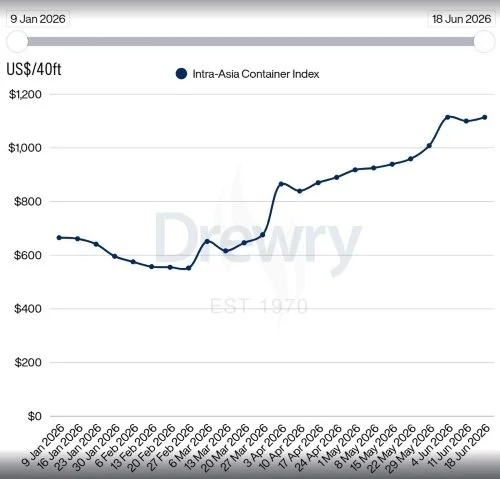
Drewry’s Intra-Asia rate graph
When discussing container freight rates, attention is often focused on the major East-West trade lanes linking Asia with Europe and North America. However, recent developments within Asia itself may be just as important for Australian importers and exporters.
According to Drewry's Intra-Asia Container Index (IACI), spot freight rates have climbed to USD $1,114 per 40ft container, their highest level since May 2023 and more than double pre-conflict levels. While this may appear to be a regional issue, the implications extend far beyond Asia's borders.
What's Driving the Increase?
Several factors are contributing to stronger demand and higher freight rates across intra-Asia trade lanes.
Manufacturers continue to diversify production away from a single-country sourcing model, resulting in increased cargo movements between China, Vietnam, Thailand, Indonesia and other Southeast Asian economies. Components, semi-finished products and finished goods are increasingly moving across multiple countries before reaching their final destination.
At the same time, ongoing geopolitical uncertainty and concerns around potential supply chain disruptions have prompted some cargo owners to bring forward peak season and Christmas shipments, adding further pressure to regional shipping networks.
The result is stronger demand for vessel space, equipment and transport capacity throughout Asia.
Why It Matters to Australia
For Australian businesses, this is not simply an Asian freight market story.
Many Australian supply chains are heavily reliant on manufacturing and distribution networks spread across Asia. Products imported into Australia often contain components sourced from multiple countries before final assembly and export.
As cargo volumes increase within Asia, competition for vessel space, containers and transhipment capacity also rises. This can contribute to higher freight rates, tighter equipment availability and increased pressure on key hub ports that support Australian trade.
In many cases, what happens within Asia directly influences shipping conditions to and from Australia.
A Changing Supply Chain Landscape
The growing importance of intra-Asia trade reflects broader changes in global supply chains. As manufacturers diversify sourcing strategies and regional trade volumes continue to grow, the movement of cargo within Asia is becoming increasingly significant in its own right.
For Australian importers, monitoring these trends can provide valuable insight into future freight market conditions and potential supply chain challenges.
While the world's largest trade lanes will always attract attention, some of the most important indicators of future market pressures may be found much closer to home.
At End to End Logistics, we continue to monitor global and regional freight market developments to help our clients navigate changing supply chain conditions and make informed logistics decisions.